Half Dollar Rolls Explained: Count, Value, and Collector Interest
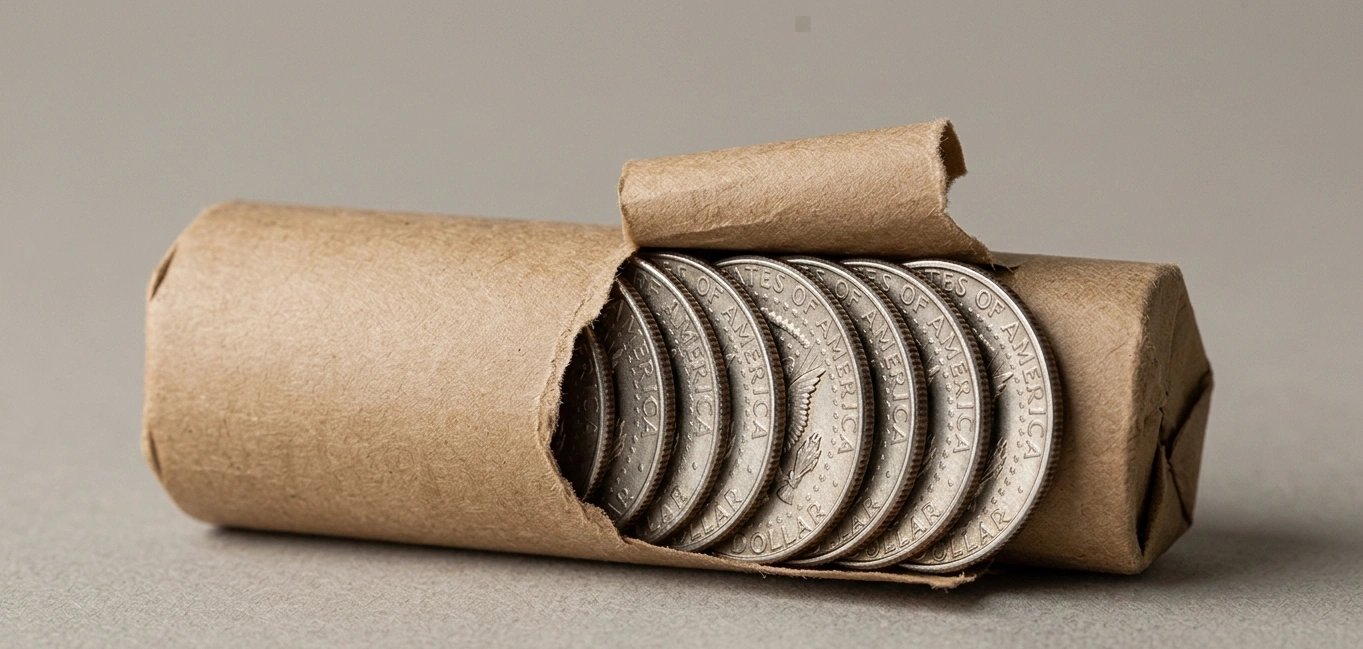
A simple roll can hide far more than its face value suggests.
Standardized bank packaging for 50-cent coins serves as a primary logistical unit within the US financial system.
This storage format ensures efficient transportation and accurate accounting of the money supply.
Investor interest in original rolls remains high in 2026 due to the precious metal content found in vintage series.
So, how many half dollars in a roll? Let’s see ↓
Characteristic | Standard Parameter |
Coins per Roll | 20 pieces |
Roll Face Value | 10.00 $ |
Individual Coin Value | 0.50 $ |
Coin Diameter | 30.61 mm |
Coin Thickness | 2.15 mm |
Automatic wrapping machines eliminate errors in the total count of specimens.
Total roll mass varies significantly depending on the production year and metal composition.
Weight differences between a 1964 Silver roll and modern Steel-based samples exceed 20 grams.
Physical Characteristics by Production Period
Technical parameters for the half dollar coin evolved during historical mint reforms.
Accurate appraisals require consideration of the specific metal used in each era.
Pre-1964 Period → 90% Silver → Coin mass: 12.50 grams
1965–1970 Period → 40% Silver → Coin mass: 11.50 grams
Post-1971 Period → Copper-Nickel Alloy → Coin mass: 11.34 grams
Transitioning away from Silver in 1971 led to the gradual disappearance of these coins from active daily use.
Modern 50-cent pieces in 2026 are primarily struck for collector sets and special orders.
Value Hierarchy for Rolled Coins
Investment potential depends on the probability of finding rare striking types within a roll.
Current market demand ranks coin series in the following descending order:
→ Walking Liberty series (pre-1947) → Franklin series (1948–1963) → 1964 Kennedy issues → 1965–1970 Silver Kennedy issues → 1976 Bicentennial commemorative issues in UNC condition
Searching through bank rolls has developed into a specialized investment niche.
Auction prices for a 1964 roll reach 450.00 $ in April 2026.
Market Dynamics for Silver Content
Rolls containing precious metals are strictly tied to global commodity exchange rates.
Price evolution for a 1965–1970 Silver Kennedy roll (20 coins) over the last three years:
2024: 165.00 $ ↓ 2025: 188.00 $ ↓ 2026: 212.00 $
Annual growth averages 13.5% provided metal prices remain stable.
Pure Silver content in one such roll totals approximately 92 grams.
Classification of Rare Years and Mintages
Production volumes for each series determine availability in unsearched conditions.
Scarcity principles applied by mints create the following high-value targets:
1970-D Kennedy
Half Dollar Mintage totaled only 2.1 million units. Issuance was restricted to official mint sets. Market value for an MS65 specimen in 2026 stands at 65.00 $.
1938-D Walking Liberty
Record-low mintage from the Great Depression era. Values for intact rolls of these coins reach tens of thousands of dollars. So/ it’s better to examine yours with the coin identifier app.
2012-P and 2012-D
These years feature no production for general circulation. Original mint-wrapped rolls fetch up to 45.00 $.
Scarcity in the open market guarantees a price increase of 5–8% annually.
Minting Errors Found Within Rolls
Probability of discovering production flaws in mint-sealed rolls remains a constant factor.
Errors confirmed by certification centers possess high liquidity in 2026.
Double Die Strikes
Occur when the blank feeding cycle is interrupted. Lot prices vary between 400.00 $and 1,200.00$.
Composition Errors
Striking 50-cent designs on blanks intended for 25-cent coins. Rarest cases reach auction prices above 5,000.00 $.
Missing Engraver Initials
Found on specific Kennedy issues. Error value is approximately 150.00 $.
Inspecting the visible edges of coins in a roll allows for identifying rim defects without opening the paper.
Durability and Preservation Analysis
Coin condition inside a roll depends on the packaging type and storage environment.
Paper rolls are more susceptible to humidity compared to plastic tubes.
Storage Type | Surface Impact | Oxidation Risk |
Original Paper Roll | Patina formation on edges | Medium |
Mint Plastic Tube | Preservation of original luster | Low |
Loose Bag Storage | Numerous contact marks | High |
Circular patina appearing on the end coins of a roll increases their market value.
Such specimens often receive MS66 grades or higher during professional appraisal.
Commemorative Series Auction Statistics
Anniversary issues packaged in rolls attract significant interest in 2026.
Lot | Condition | Sale Price | Date |
1964 Kennedy Roll (20 pcs) | UNC | 460.00 $ | Jan 2026 |
Bicentennial Silver Roll | MS67 | 820.00 $ | Mar 2026 |
1963 Franklin Roll | GEM | 1,150.00 $ | Apr 2026 |
Market availability for original Franklin rolls decreases by 4% annually.
This trend is driven by collectors opening rolls for individual grading purposes.
Professional Valuation Methodology
Closed roll value does not always equal the sum of the individual coins inside.
Experts prioritize packaging integrity and the authenticity of bank stamps.
Verification steps include:
Precise weighing with 0.01-gram accuracy.
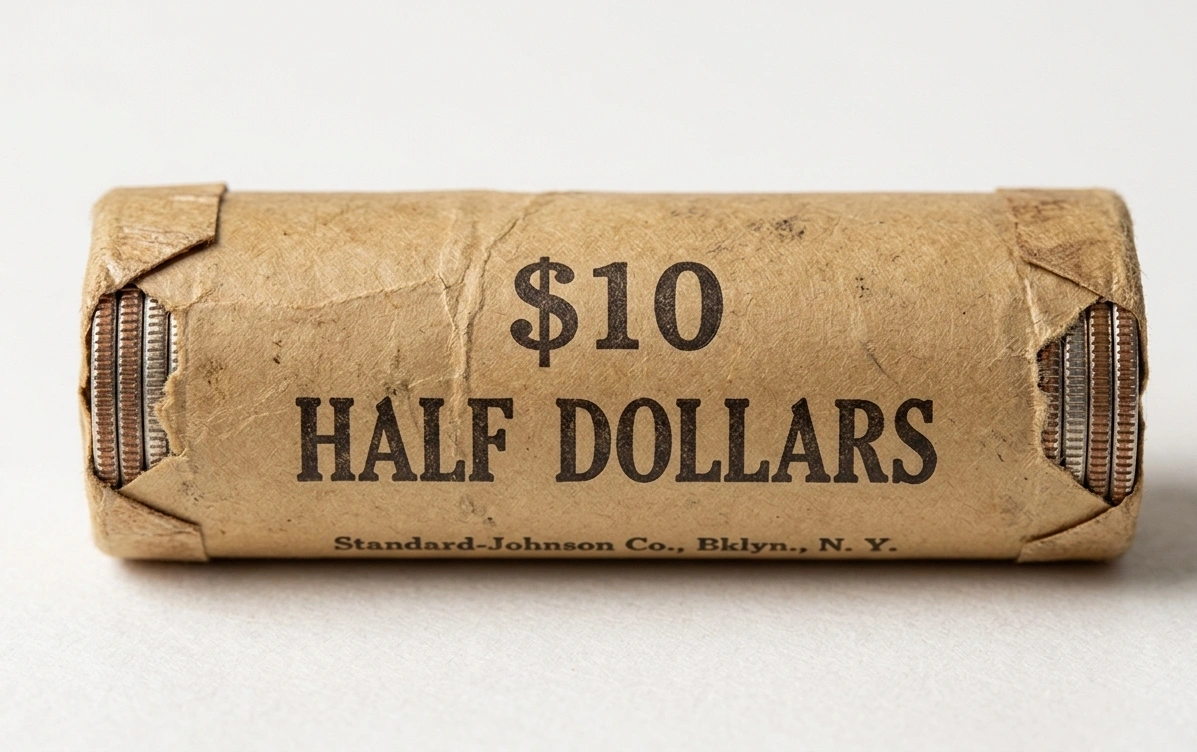
Font verification on the paper wrapper.
Usage of the coin finder app
Analysis of tampering signs or re-crimped edges.
Date checking on both visible ends.
Matching dates on both ends increases confidence in the roll's contents.
Confirmed original rolls from the 1960s trade at a 15% premium over individual coins in 2026.
Inflation Impact on the Half Dollar Market
Face value of 10.00 $ in 2026 has different purchasing power compared to 2000.
Numismatic value, however, tends to grow faster than the consumer price index.
Silver rolls are viewed as a hedge against currency devaluation.
5-Year Silver Roll Yield → +68%
5-Year Gold Coin Yield → +52%
5-Year Bond Yield → +22%
Metallic content provides a price floor independent of market volatility.
Demand for physical assets in the US reached a ten-year peak in early 2026.
Walking Liberty Series Specifics
Walking Liberty coins are considered among the most aesthetic in US history.
Locating a full, original roll of these coins in 2026 is an exceptional event.
Most surviving specimens were removed from circulation by the mid-1950s.
→ High-relief design leads to rapid detail wear → Uncirculated specimens are extremely scarce → Single coins from the 1940s start at 25.00 $
Average roll price for Walking Liberty coins in circulated condition is approximately 550.00 $.
High-quality specimens in a roll can exceed 3,000.00 $.
Influence of the San Francisco Mint (S)
Coins bearing the 'S' mint mark are primarily struck as Proofs.
Occasionally, these coins enter bank rolls by error or within special series.
Individual Kennedy coins with an 'S' mark found in standard rolls fetch 5.00 $ in 2026.
This represents a tenfold increase over face value.
Discovery rates for these coins in general circulation are 1 in 500 pieces.
Forgery Risks in the Roll Segment
Rising prices for rare 50-cent coins encourage the creation of "artificial" rolls.
Fraudsters use old paper to mimic vintage bank wrapping.
Primary signs of imitation in 2026:
Paper condition appearing too clean for the stated age.
Weight mismatches regarding the claimed metal content.
Presence of different years inside a supposedly "original" roll.
X-ray inspection services allow for dating every coin inside a roll without opening it.
This technology became widely available in major numismatic centers in New York and Chicago this year.